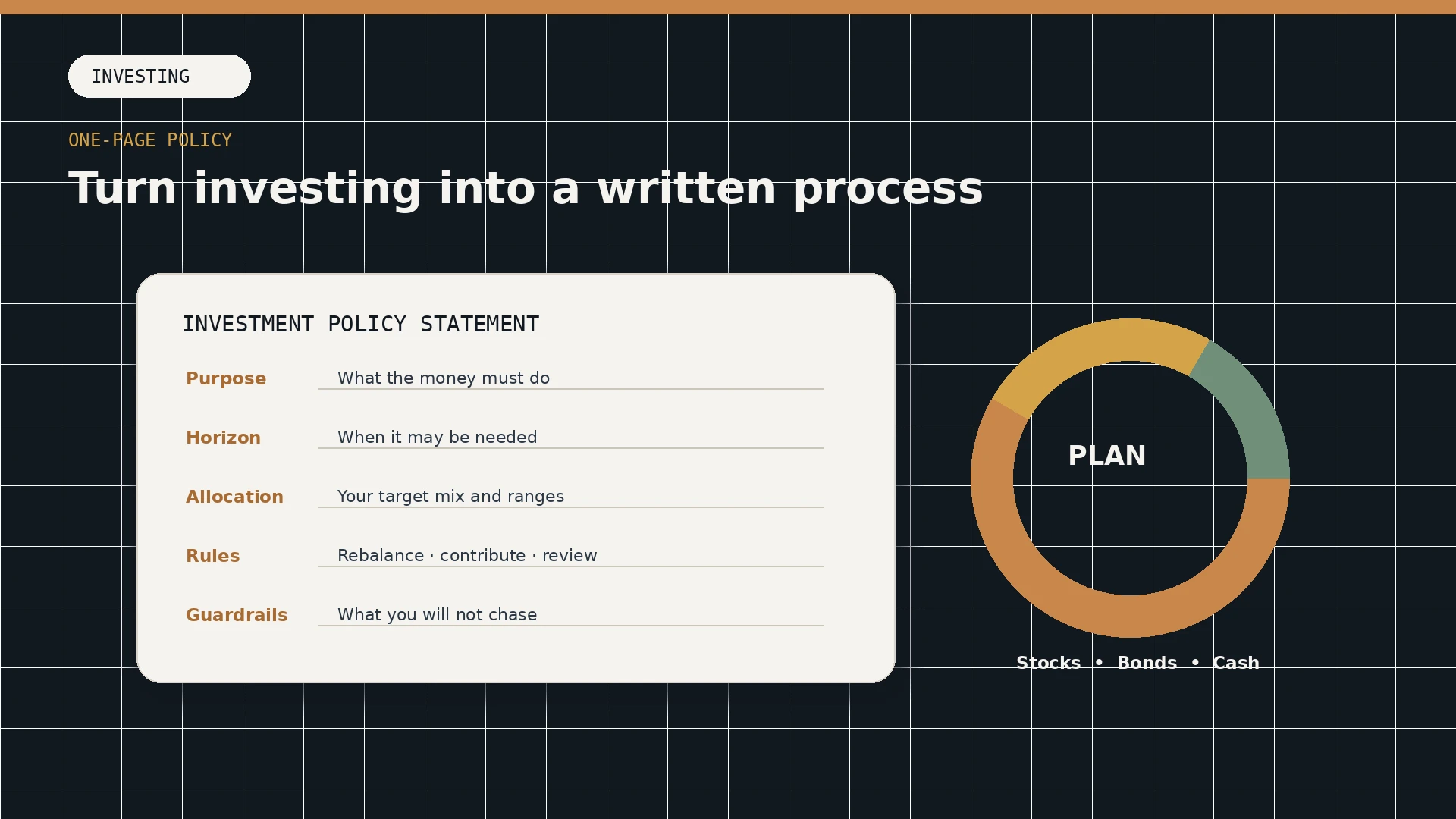
For investment decisions that should remain stable through market stress, record the rules in a one-page investment policy statement before choosing products.
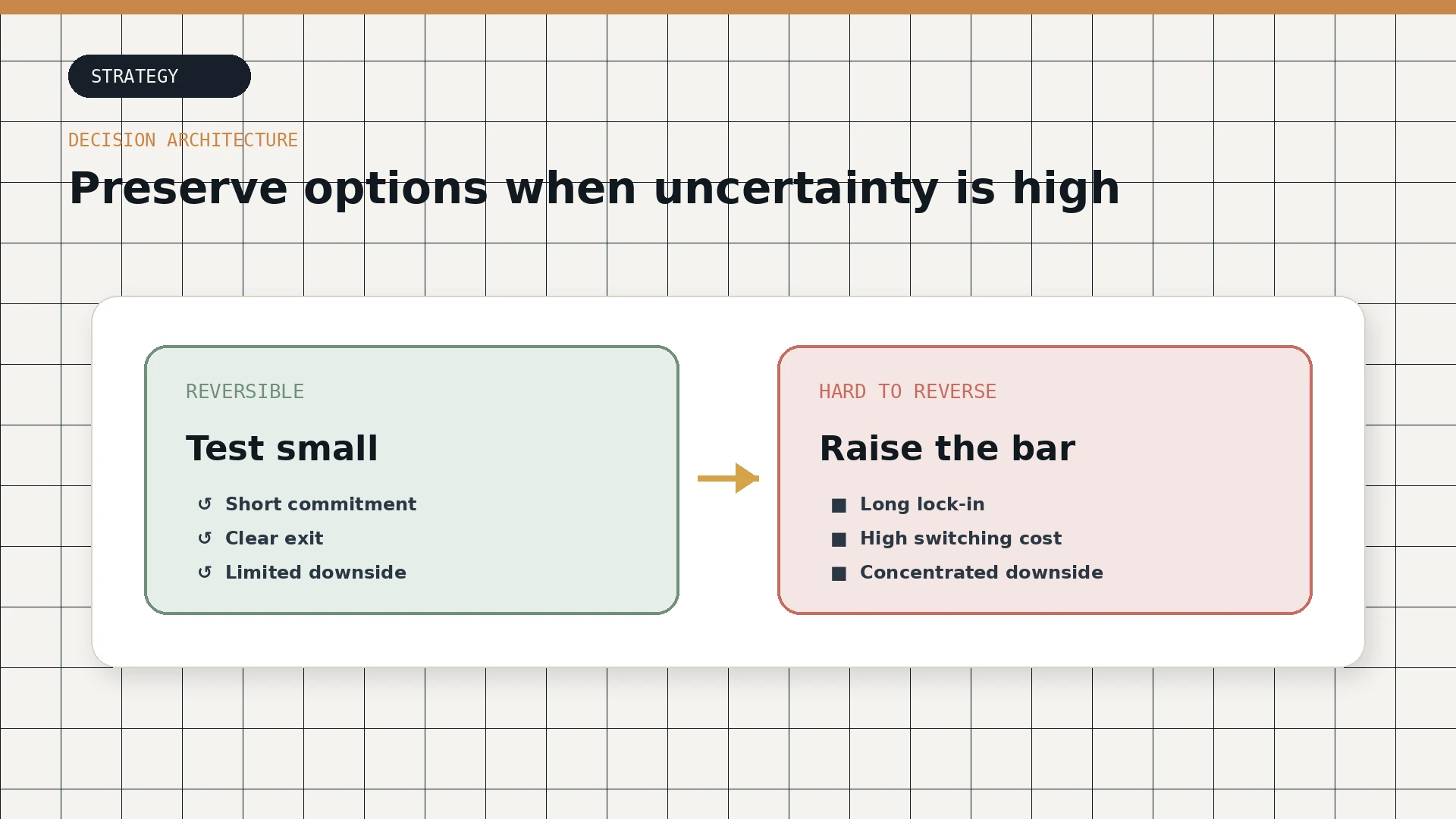
Two decisions can have the same expected payoff and very different risk because one can be reversed next week while the other locks the household in for years. Reversibility is not the only criterion, but it determines how much evidence, margin, and planning a decision deserves.
That difference should change the size, duration, and evidence standard of the first commitment.
A reversible decision has a limited cost of exit, a short commitment, and useful information after the test. An irreversible or hard-to-reverse decision has high transaction costs, long contracts, debt, illiquidity, legal consequences, or a large opportunity cost.
Build a reversibility score
Rate the decision from 0 to 2 on each factor:
| Factor | 0 | 1 | 2 |
|---|---|---|---|
| Contract length | None or short | Moderate | Long or difficult to cancel |
| Exit cost | Minimal | Noticeable | Large fee, tax, or loss |
| Debt or guarantee | None | Limited | Material personal obligation |
| Liquidity | Easy resale | Uncertain | Illiquid or specialized |
| Location or career lock-in | None | Some | Major move or narrow path |
| Concentration | Diversified | Moderate | One employer, asset, or client |
A high score does not automatically reject the decision. It means the decision needs stronger evidence and a larger safety margin.
Use reversible tests to buy information
Examples include:
- Rent in a new city before buying a home.
- Freelance for one client before leaving a stable job.
- Pilot a product before ordering inventory.
- Increase an investment allocation gradually instead of making a concentrated bet.
- Use a short course or project to test career fit before financing a long program.
- Negotiate a trial period or cancellation clause.
The test should answer a specific uncertainty. “Try it and see” is weak. Define the metric, time limit, maximum cost, and stop rule.
How much commitment should you make now?
Run a small test quickly and collect real information.
Set a time and budget cap before testing.
Stage it, preserve an exit fund, and require milestone evidence.
Raise the evidence standard, stress test the downside, and negotiate contingencies.
Price the full exit
Before entering, estimate:
- Contract termination and transaction fees
- Taxes
- Resale discount
- Moving or reinstallation costs
- Time without income
- Training that does not transfer
- Lost benefits or vesting
- Credit or legal effects
- Emotional and family disruption
The exit cost belongs in the original decision, not in a later postmortem.
Preserve option value
An option has value when it allows you to wait for better information or choose among several paths. Cash reserves, portable skills, diversified income, short contracts, and low fixed costs all preserve option value.
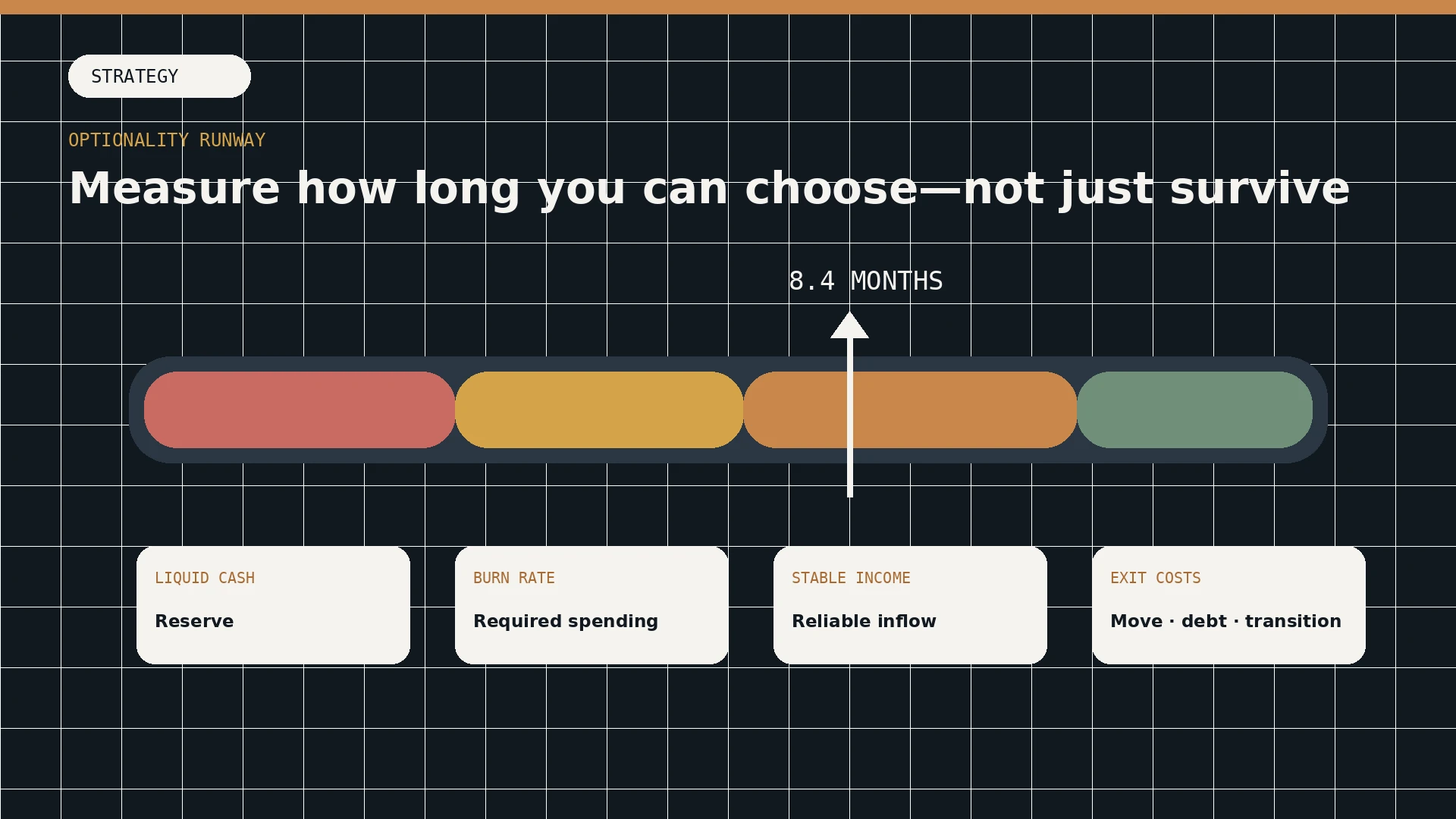
Optionality is not indecision. It is a deliberate asset when uncertainty is high and the cost of waiting is lower than the cost of a wrong commitment. The Financial Optionality Runway guide measures how long the household can keep that choice.
Know when waiting is expensive
Delay also has a cost. A reversible opportunity may disappear, compound growth may be postponed, or a preventable problem may worsen. Compare:
- Cost of acting now and being wrong
- Cost of waiting and losing the opportunity
- Information expected during the waiting period
- Ability to reverse after acting
Structure the commitment
| Scenario | Best for | Upside | Main trade-off | Next step |
|---|---|---|---|---|
| Pilot | New service, side income, city, or workflow | Buys real information cheaply | Results may not scale perfectly | Set a fixed test period and success metric |
| Staged commitment | Education, business, portfolio shift | Limits downside while evidence accumulates | May cost more than committing once | Tie each stage to a milestone |
| Full commitment | Evidence is strong and timing matters | Captures the complete benefit | Exit can be expensive | Fund contingencies and document the exit plan |
| Wait | Uncertainty will resolve and delay is cheap | Preserves cash and choice | May lose time or opportunity | Set the date and evidence that end the wait |
Apply the framework to common money choices
Home purchase
Hard to reverse because of closing costs, debt, location, maintenance, and resale risk. A rental period, inspection, conservative payment test, and dedicated move/repair reserve can reduce uncertainty.
Career change
Training may be reversible; leaving a role, pension, visa status, or health coverage may not be. Test the work, map transferable skills, and calculate runway before resigning.
Business launch
A service business with one client and low fixed cost is more reversible than inventory, a lease, employees, and personal guarantees. Match the capital structure to the evidence.
Investment
A liquid diversified fund may be easy to sell but still create tax and market loss. A private, leveraged, or concentrated investment has additional lock-in. Liquidity alone does not eliminate risk.
Turn the page into action
Score the next major decision
- List the contract, debt, tax, liquidity, location, and concentration lock-ins.
- Estimate the full exit cost before entering.
- Identify the largest uncertainty and the cheapest valid test.
- Set the test budget, duration, success metric, and stop rule.
- Preserve a cash reserve and a realistic exit path.
- Choose a date when waiting will be reviewed rather than extended automatically.
Evidence
Sources
- Your Money, Your Goals toolkit
Consumer Financial Protection BureauAccessedAugust 18, 2026
- Asset Allocation and Diversification
U.S. Securities and Exchange Commission — Investor.govAccessedAugust 18, 2026
- Plan your business
U.S. Small Business AdministrationAccessedAugust 18, 2026
Common questions
Frequently asked questions
What makes a financial decision hard to reverse?
Long contracts, transaction costs, taxes, debt, illiquidity, career-specific investment, relocation, guarantees, and concentrated exposure can make reversal slow or expensive.
Should every reversible decision be taken?
No. Reversibility lowers the cost of learning; it does not make a bad option good. The test still needs a clear purpose, downside limit, and stop rule.
How can I reduce the risk of an irreversible decision?
Stage the commitment, preserve cash, negotiate contingencies, rent or pilot before buying, diversify counterparties, and define the evidence required before each larger step.