Once the matrix exposes the weakest dependency, use the income concentration risk guide to turn that finding into a measured diversification test.
Portable income is income that can continue when location, employer, schedule, or customer mix changes. “Remote” describes where work happens; it does not guarantee that the income can cross a state or national border, survive one client loss, or continue without the worker’s daily hours.
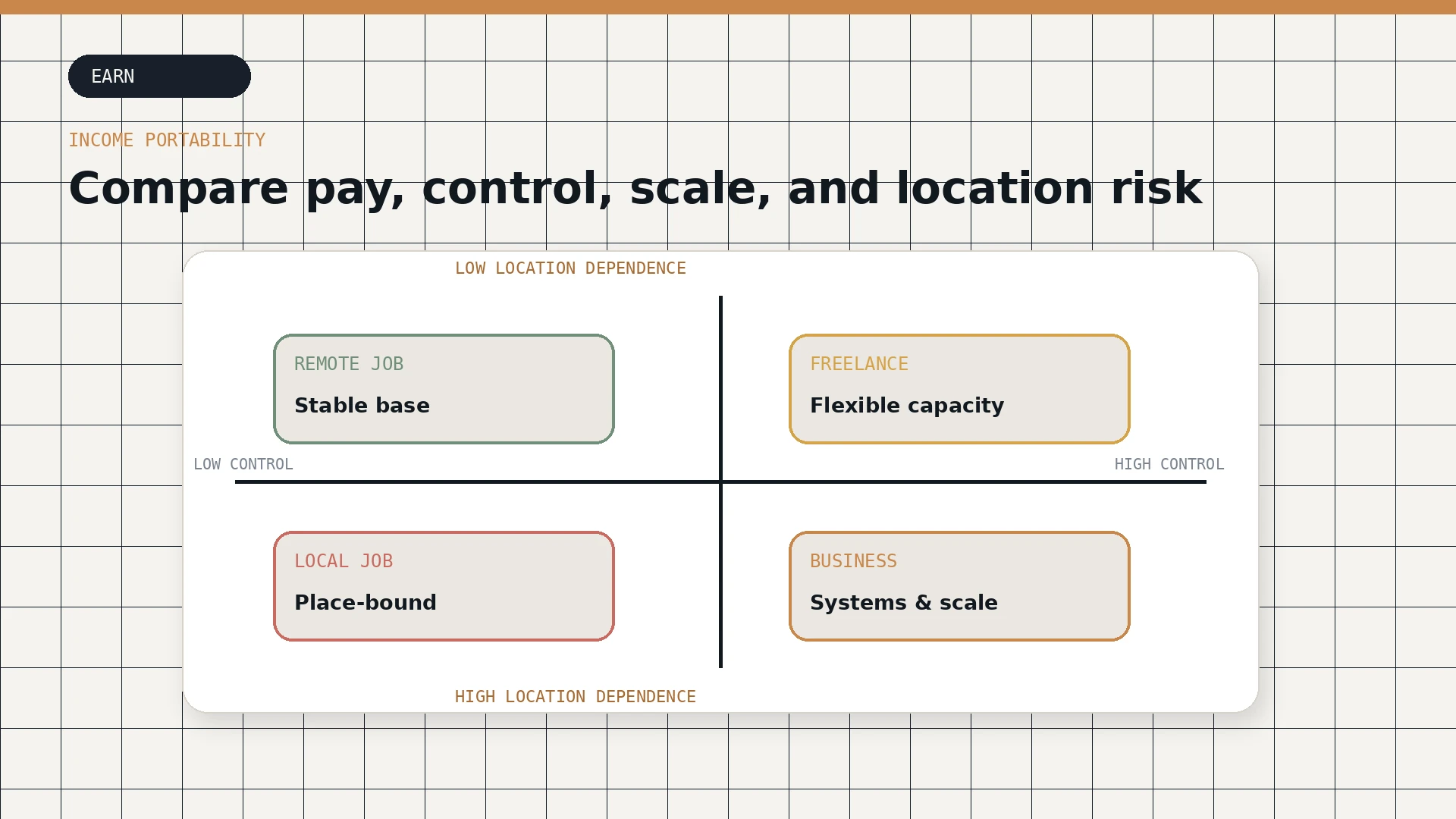
The matrix compares four broad models: local employment, remote employment, freelancing, and business systems. None is universally best. The goal is to see which risks the household is accepting and which protections must be rebuilt.
Dimension 1: location dependence
Ask where the work can be performed under the employer, contract, license, tax, data-security, insurance, and immigration rules. A company may allow home work in one state but prohibit international work. A licensed profession may be remote but limited to clients in specific jurisdictions.
Get written confirmation before relocating. A manager’s informal approval may not resolve payroll, permanent-establishment, visa, or client-contract issues.
Dimension 2: buyer concentration
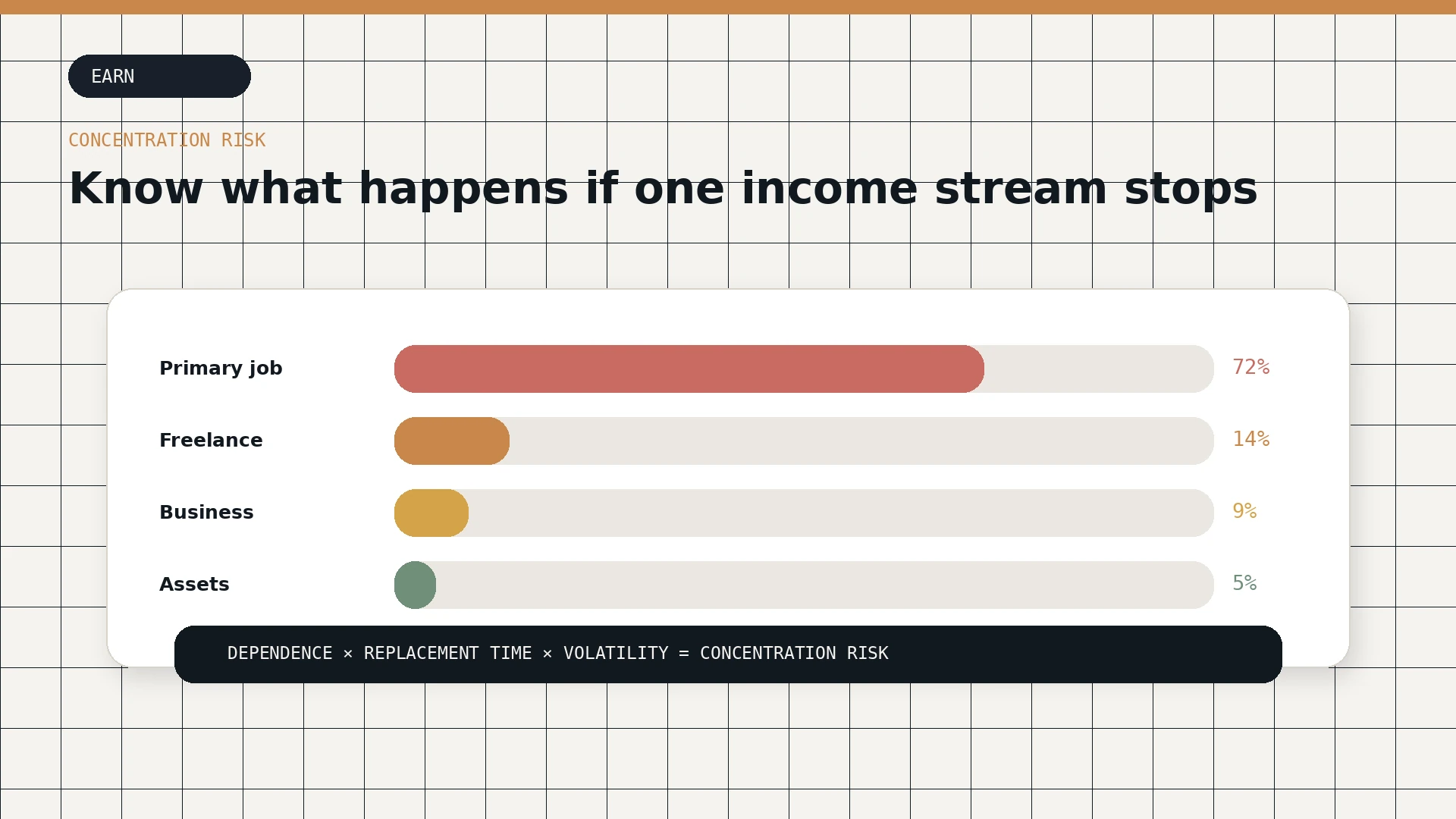
A salary usually depends on one employer. A freelancer with one major client may have the same concentration without severance or benefits. A business with hundreds of customers may be diversified, but a single marketplace or payment processor can still be a hidden buyer.
Measure the percentage of income from the largest employer, client, product, platform, and country.
Dimension 3: time and system dependence
Employment and freelance services often exchange time for income. A business can scale through employees, software, licensing, products, or repeatable processes, but scaling creates capital, compliance, quality, and management risk.
Income assets such as royalties, licensing, or investments may require less daily labor, yet they still carry market, platform, legal, and concentration risk. “Passive” should never mean “unmonitored.”
Dimension 4: household cost transfer
A higher freelance rate is not directly comparable with a salary. The household may need to fund:
- Employer payroll taxes or self-employment tax effects
- Health insurance and other benefits
- Unpaid leave and holidays
- Retirement contributions
- Equipment and software
- Liability or professional insurance
- Accounting and legal support
- Sales time and unbillable administration
- Bad debt and delayed payment
Compare after-tax, after-expense, risk-adjusted cash—not headline revenue.
Which income path is most useful now?
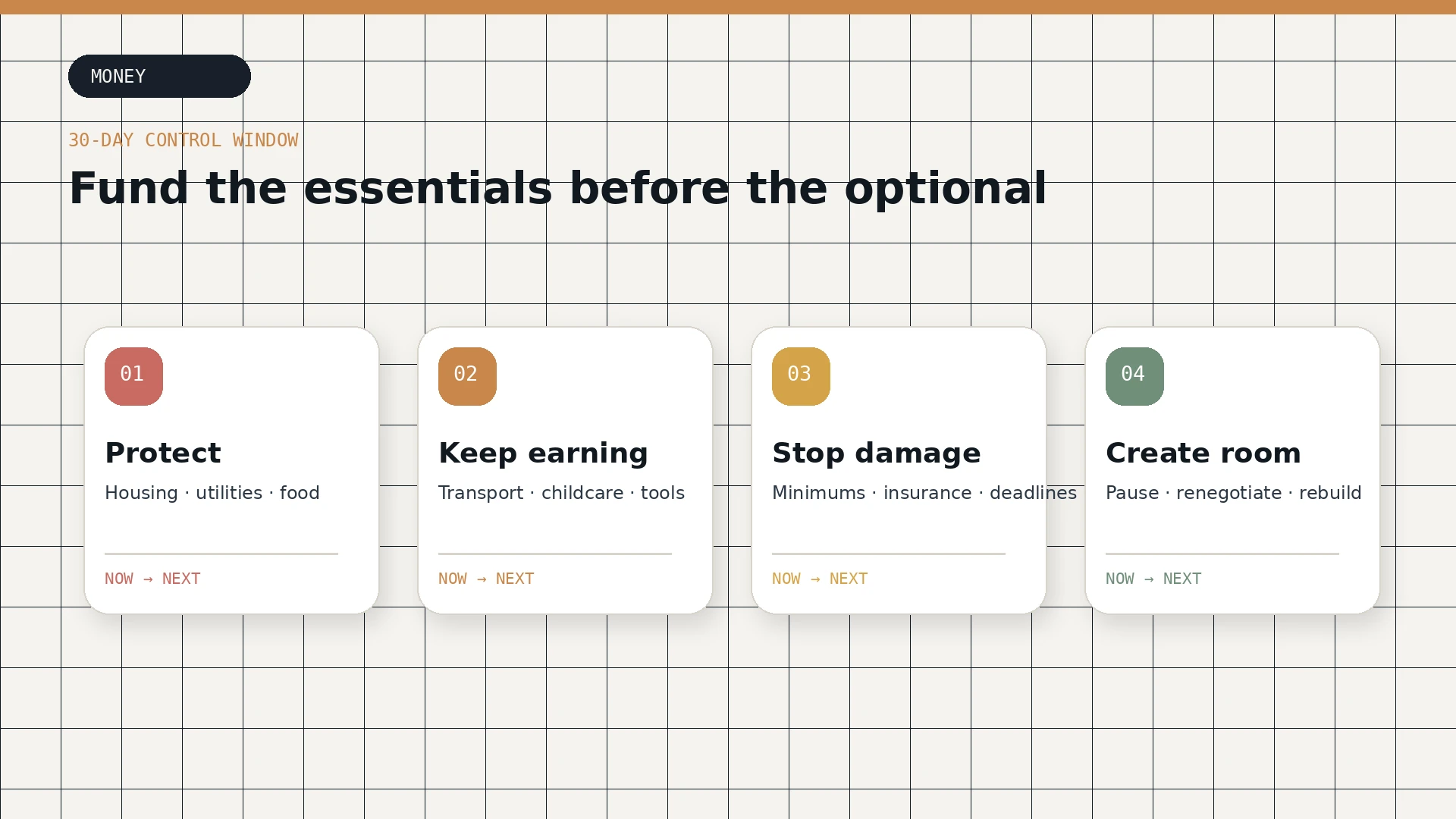
Prioritize employment or contracted recurring income with clear benefits and location rules.
Build freelance capacity while limiting client concentration and funding taxes.
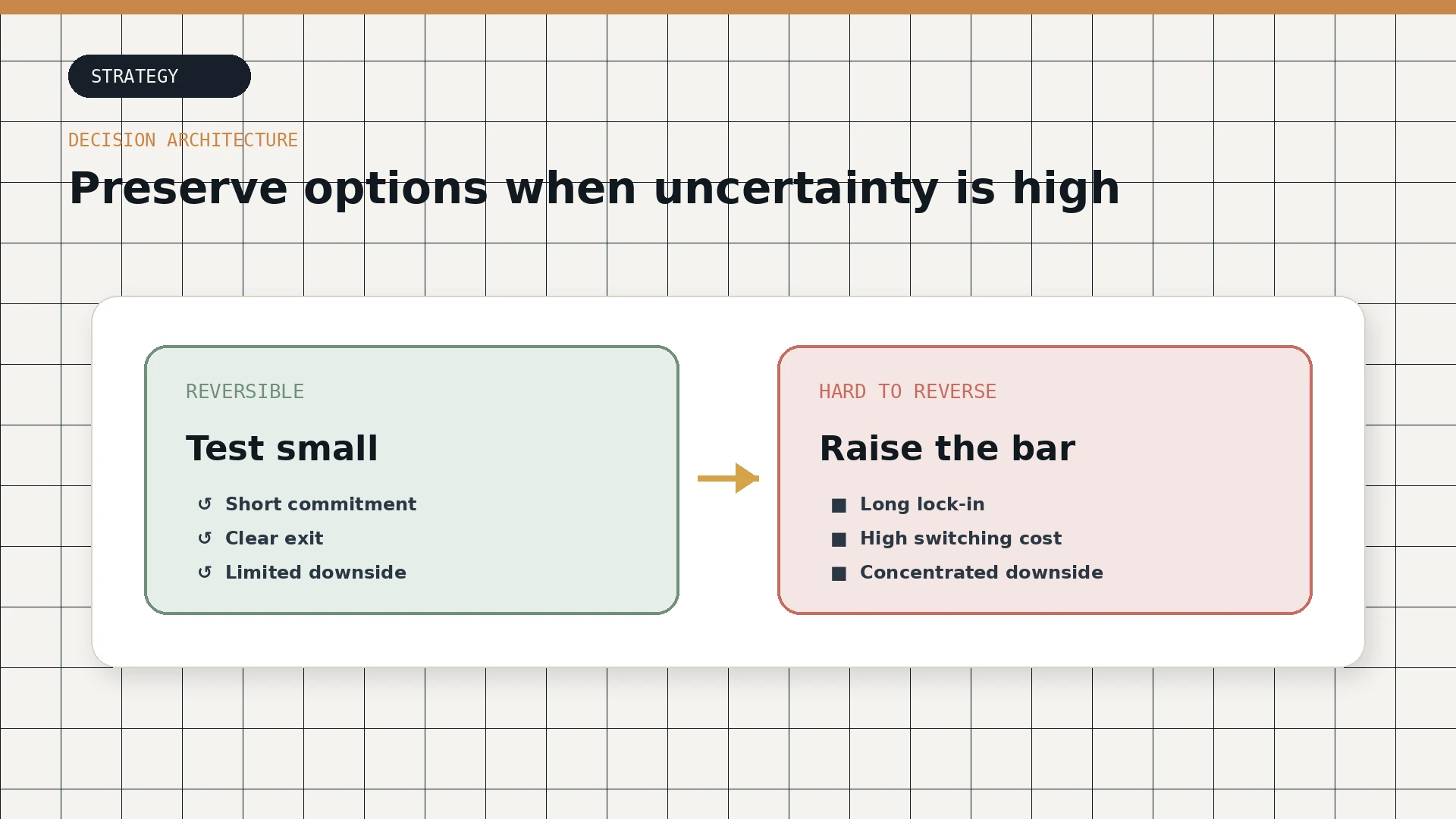
Test a business system before adding fixed costs or guarantees.
Verify legal work, payroll, tax, licensing, security, and payment access before moving.
Score each path
Use a 1-to-5 score for:
- Net monthly cash
- Volatility
- Largest-buyer concentration
- Geographic permission
- Schedule control
- Benefits and insurance
- Taxes and administration
- Startup or switching cost
- Time to first income
- Scalability
- Transferability of skills and customers
Weight the categories based on the household’s current pressure. A family preparing to relocate may weight legal location permission and health coverage more than maximum upside.
Compare the main income structures
| Scenario | Best for | Upside | Main trade-off | Next step |
|---|---|---|---|---|
| Local job | Stable work tied to a place or facility | Predictable pay and possible benefits | Low geographic flexibility and one employer | Build transferable skills and a relocation trigger |
| Remote job | Stable base with approved remote location | Salary plus location flexibility | Employer and jurisdiction restrictions remain | Verify policy, payroll, security, and benefits in writing |
| Freelance | Marketable service and several buyers | Client and schedule control | Variable demand, taxes, benefits, and sales burden | Set a rate floor, tax reserve, and concentration limit |
| Business system | Repeatable demand beyond personal hours | Potential scale and asset value | Capital, operations, compliance, and platform risk | Pilot demand before adding fixed costs |
Build a portfolio instead of choosing one identity
The household can combine paths:
- Stable job plus one freelance client
- Part-time employment plus a small business
- Freelance service plus a digital product
- Business income plus diversified investment income
The objective is not to remain busy in every category. Each stream should solve a different risk: stability, flexibility, upside, or long-term independence.
Verify classification and compliance
Worker classification depends on law and facts, not the label in a contract. Tax, labor, licensing, immigration, and business rules change. Use current federal, state, local, and destination-country guidance and obtain professional advice when the move or business creates material exposure.
Do not accept “contractor” status merely because it appears more portable if the arrangement transfers costs without real control or independent business capacity.
Set a portability milestone
Examples:
- No client exceeds 35% of freelance revenue.
- Remote work is approved for the destination in writing.
- Three months of tax and operating reserves are funded.
- The business can deliver for two weeks without the founder’s daily intervention.
- Skills and portfolio are usable outside the current employer.
Turn the page into action
Map your income portability
- Verify where the work may legally and operationally be performed.
- Measure the largest employer, client, product, and platform shares.
- Compare after-tax, after-benefit, after-expense cash.
- Score stability, control, location permission, switching cost, and scale.
- Test the next income path before adding fixed costs or leaving the base income.
- Set one measurable portability milestone for the next 90 days.
Evidence
Sources
- Occupational Outlook Handbook
U.S. Bureau of Labor StatisticsAccessedAugust 18, 2026
- Self-Employment Tax (Social Security and Medicare Taxes)
Internal Revenue ServiceAccessedAugust 18, 2026
- Misclassification Initiative
U.S. Department of LaborAccessedAugust 18, 2026
- Plan your business
U.S. Small Business AdministrationAccessedAugust 18, 2026
Common questions
Frequently asked questions
Is remote employment automatically portable?
No. The employer may restrict states or countries because of payroll, tax, licensing, security, export-control, benefits, or client requirements. Portability depends on written policy and the actual work.
Is freelancing more stable than employment?
Freelancing can diversify buyers, but income may be variable and benefits, taxes, sales, and administration shift to the worker. Stability depends on client concentration, contract terms, pipeline, and reserves.
What is the most portable type of income?
Portability is multi-dimensional. Income that can be performed anywhere may still depend on one platform, license, client, currency, or payment system. The strongest design combines geographic flexibility with buyer and operational diversification.