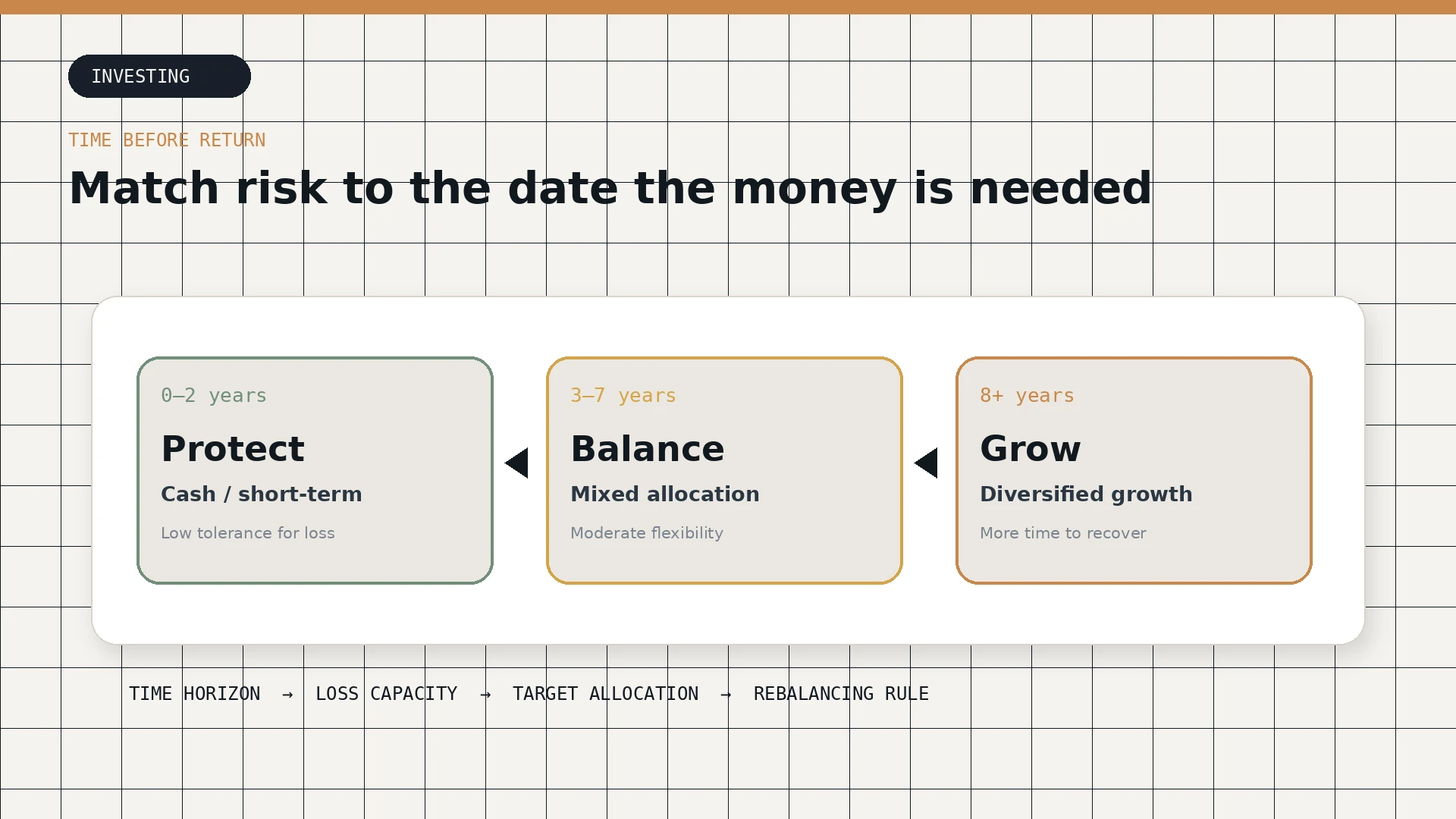
Use the asset allocation by time horizon guide to supply the goal-specific stock, bond, and cash ranges that the policy statement records.
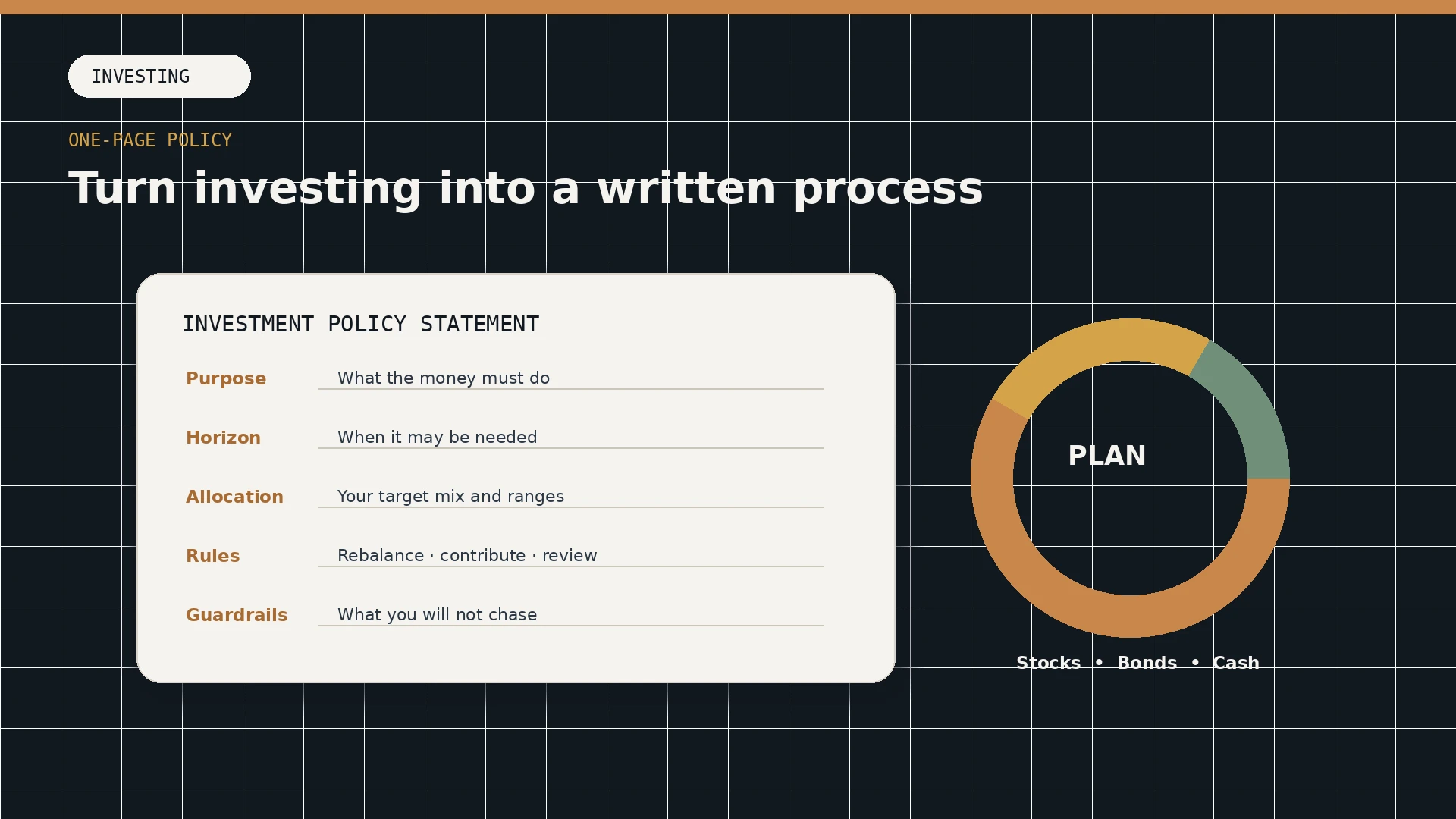
An investment policy statement is a decision made in advance. It converts a broad goal such as “retire comfortably” or “build long-term wealth” into rules that can survive enthusiasm, fear, market noise, and changing product promotions.
The document does not need institutional language. One page is often enough for an individual or household. The test is whether another careful person could read it and understand what the portfolio is supposed to do, which risks are acceptable, and what action is required when markets move.
Section 1: define the purpose
Start with one sentence:
This portfolio exists to ______ by ______.
Examples:
- Fund retirement spending beginning around 2055.
- Build a future home down payment that may be used after 2032.
- Invest money not required for emergency reserves or known goals for at least 15 years.
A portfolio with several goals should either separate them into distinct accounts or state how each goal is protected. Money needed in two years should not be governed by the same risk rule as money intended for retirement decades later.
Section 2: state the time horizon and withdrawals
Write the earliest likely withdrawal date, expected withdrawal pattern, and whether the date is flexible. “Long term” is too vague. A 10-year horizon with a fixed tuition bill is different from a 10-year goal that can be postponed.
Include known cash flows:
- Initial balance
- Expected monthly or annual contributions
- Employer contributions
- Planned withdrawals
- Large one-time additions or distributions
- Taxes or fees paid from the account
The Investment & Savings Calculator can help test whether the contribution plan and assumed return are internally consistent, but the policy should not promise a return.
Section 3: define risk capacity separately from risk comfort
Risk comfort is how you feel during losses. Risk capacity is how much loss the plan can absorb without failing. Capacity depends on horizon, flexibility, income stability, reserve cash, debt, insurance, and the size of the goal relative to the portfolio.
A person may feel comfortable with volatility but have low capacity because a home purchase is near. Another may dislike market declines but have high capacity because retirement is decades away and contributions are stable.
The policy should be limited by the lower of the two. A plan that cannot be followed is not practical; a plan that cannot survive the required withdrawal is not viable.
What should determine the allocation?
Prioritize capital stability and liquidity over maximum expected return.
Use a balanced mix and reduce risk as the date approaches.
A diversified growth allocation may be appropriate within your loss capacity.
Clarify the plan before selecting products or return assumptions.
Section 4: write the target allocation and ranges
Use broad asset classes that have a clear role. A simple policy might state:
| Asset class | Target | Acceptable range | Job |
|---|---|---|---|
| Diversified stocks | 70% | 65%–75% | Long-term growth |
| High-quality bonds | 25% | 20%–30% | Stability and rebalancing capacity |
| Cash | 5% | 2%–8% | Near-term withdrawals and fees |
These numbers are examples, not recommendations. The correct mix depends on the goal. The ranges prevent constant trading while defining when action is required.
Also state concentration limits. Examples include a maximum allocation to a single company, employer stock, country, sector, speculative asset, or illiquid investment. A position can be attractive and still be too large for the household.
Section 5: define contributions and rebalancing
Choose a contribution rule that does not depend on mood:
- Fixed amount each pay period
- Fixed percentage of income
- Minimum contribution plus a percentage of bonuses
- Quarterly sweep from business or variable income
Then choose a rebalancing rule. Common approaches include:
- Review annually and return to targets.
- Rebalance when an asset class leaves its acceptable range.
- Use new contributions and withdrawals first, then trade only if needed.
Include tax and transaction-cost awareness. Rebalancing inside a tax-advantaged account may differ from selling appreciated assets in a taxable account. The policy can require a tax review without prescribing individual tax advice.
Section 6: define selection standards
Write the criteria that a product must meet before it enters the portfolio. Examples:
- The role in the allocation is explicit.
- Costs and trading spreads are understood.
- The investment is liquid enough for its job.
- The benchmark and source of return are understandable.
- The account, custodian, and protections are appropriate.
- The investment does not violate the concentration limit.
Avoid rules based on recent performance, social-media attention, or a forecast that cannot be tested.
Section 7: write behavior guardrails
The most valuable lines may be the actions you prohibit:
- Do not change the allocation because of a single news event.
- Do not borrow to invest unless a separate written leverage policy exists.
- Do not add an investment that cannot be explained in plain language.
- Do not sell solely because the portfolio declined.
- Do not use emergency savings to meet a contribution target.
- Do not increase concentration to recover a prior loss.
Distinguish a policy change from a market reaction
| Scenario | Best for | Upside | Main trade-off | Next step |
|---|---|---|---|---|
| Life changed | New goal, retirement date, income, family, relocation | The policy stays aligned with reality | May require taxes, costs, or a slower transition | Rewrite purpose, horizon, cash flows, then allocation |
| Allocation drifted | Portfolio moved outside its stated ranges | Rebalancing restores intended risk | May create taxes or transaction costs | Use contributions first, then trade deliberately |
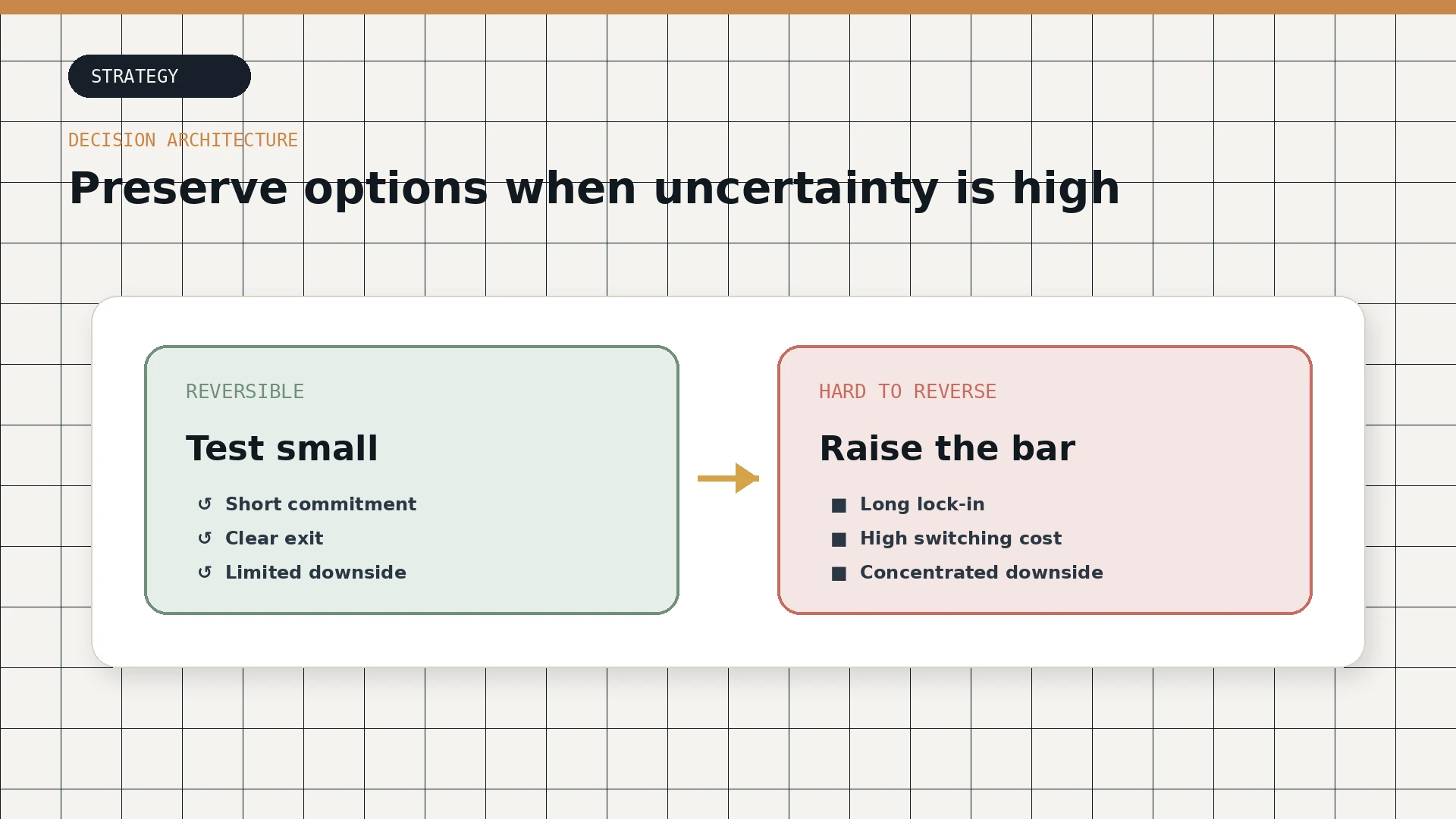
| Market forecast changed | News, commentary, short-term prediction | Usually none for a long-term policy | Creates timing risk and inconsistency | Follow the existing rule unless the goal changed |
| Product no longer fits | Cost, structure, liquidity, benchmark, or provider changed | Improves implementation without changing the goal | Requires transition analysis | Replace the product while preserving the allocation role |
The finished one-page template
Your final document should contain:
- Purpose and target date
- Contribution and withdrawal assumptions
- Risk capacity and key constraints
- Target allocation and permitted ranges
- Contribution and rebalancing rules
- Selection and cost standards
- Concentration limits
- Prohibited behaviors
- Review schedule
- Conditions that justify a policy change
Sign and date it. The signature is not a legal requirement; it is a reminder that the policy represents a deliberate commitment rather than a temporary opinion.
Turn the page into action
Write the policy before choosing another investment
- Write the purpose, earliest use date, and flexibility of the goal.
- Separate risk capacity from emotional risk comfort.
- Set a target allocation and acceptable ranges.
- Define contribution and rebalancing rules.
- Set cost, liquidity, and concentration standards.
- List behaviors the plan prohibits and schedule the next review.
Evidence
Sources
- Asset Allocation and Diversification
U.S. Securities and Exchange Commission — Investor.govAccessedAugust 18, 2026
- Beginner's Guide to Asset Allocation, Diversification, and Rebalancing
U.S. Securities and Exchange Commission — Investor.govAccessedAugust 18, 2026
Common questions
Frequently asked questions
Do individual investors need an investment policy statement?
A formal institutional document is not required, but a short written policy helps an individual separate long-term rules from short-term market emotion. The value comes from deciding purpose, horizon, allocation, and review rules before a stressful event.
How often should an investment policy be reviewed?
Review it on a fixed schedule and after a genuine life change such as a new goal, retirement date, income shift, relocation, or change in risk capacity. A market headline by itself is not a reason to rewrite the policy.
Should the policy include individual investments?
It may name permitted account types or broad asset classes, but it should avoid becoming a list of current favorites. A durable policy describes the role, limits, costs, and review rule for holdings.