Before sending every spare dollar to debt, set the first savings layer with the emergency fund order of operations so a small shock does not restart the borrowing cycle.
A debt plan fails when it optimizes interest while ignoring cash flow, or protects cash flow while never reducing expensive principal. A durable sequence has two layers: stability for every account and concentration on one target.
Start with a complete debt inventory. For each account, record:
- Current balance
- Interest rate and whether it can change
- Required minimum
- Due date
- Remaining term
- Collateral or consequence of default
- Promotional or penalty dates
- Fees
- Tax or legal considerations that require professional review
Do not rely on a credit report alone. Use current statements and contracts because reporting may lag and may not include every obligation.
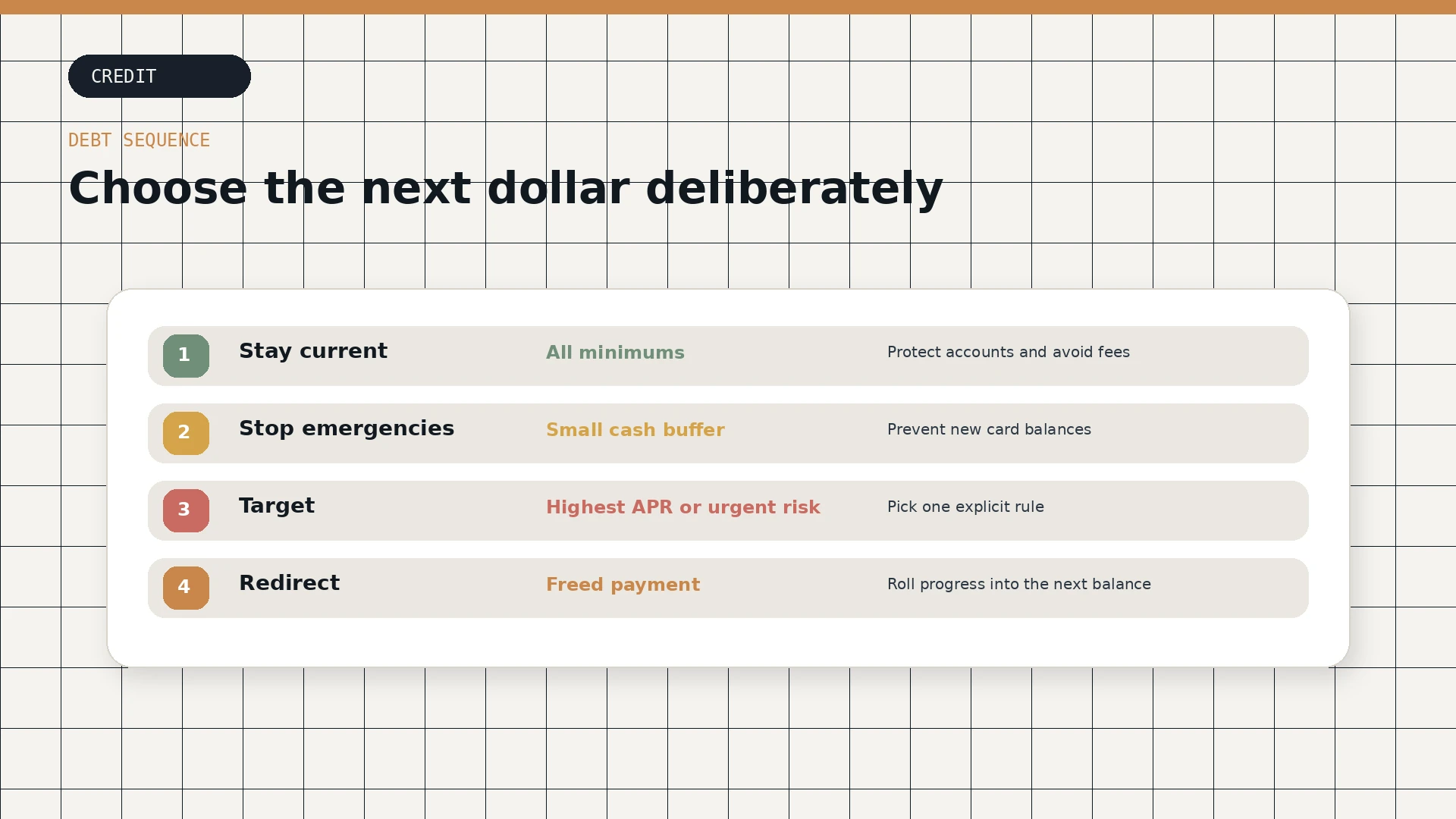
Step 1: protect all minimums
A repayment strategy is not a license to miss other required payments. Keep every affordable account current, or contact the creditor before the due date to request a hardship arrangement. A missed payment can create fees, penalty terms, collection activity, loss of collateral, or credit damage that exceeds the interest saved on the target account.
If the minimums themselves are unaffordable, the problem is not repayment order. It is cash-flow restructuring, hardship negotiation, or insolvency risk. Stop extra payments and address that first.
Step 2: hold a small operating buffer
A plan that uses every dollar for debt and then borrows for groceries, medicine, or a repair is moving backward. Keep a small reserve appropriate to the household before accelerating repayment.
The buffer is not a reason to postpone high-cost debt indefinitely. Set a defined Tier 1 target and a refill rule. Extra cash above that target goes to the chosen debt unless another explicit priority is active.
Step 3: choose the target rule
Highest APR first
The avalanche method directs extra money to the highest effective interest rate. It generally minimizes interest when balances, payments, and timing are otherwise equal. Use the actual rate that applies now and note promotional expiration dates.
Smallest balance first
The snowball method targets the smallest balance. It may produce a faster account closure and a visible payment release, but it can cost more interest. It is reasonable when the behavioral benefit or cash-flow simplification is worth the cost and the choice is made knowingly.
Highest immediate risk first
A different priority may be justified when an obligation threatens housing, transportation required for work, insurance, taxes, legal status, or essential services. This is not a general invitation to ignore APR. Write the reason, target amount, and date when the normal sequence resumes.
Promotional deadline first
A balance with deferred interest or an expiring promotional rate may become urgent. Confirm how interest is calculated, what balance must be paid, and the exact deadline. Model the payment required rather than assuming the current minimum will finish in time.
Which debt receives the next extra payment?
Stop extra payments and stabilize all required accounts first.
Fund the defined Tier 1 emergency buffer.
Address that risk with a documented exception.
Target the highest effective APR or the explicit snowball balance.
Step 4: fix the payment amount
The payoff plan needs a dollar amount, not a hope to “pay extra.” Add the target minimum to a fixed extra payment. Use the Credit Card Payoff Calculator for revolving debt or the Loan Repayment Calculator for installment debt to compare payoff time, interest, extra principal, promotional periods, or refinance offers.
For variable income, choose a conservative base payment plus a rule for excess income. Example: pay the normal target each month, then send 40% of income above the base plan after taxes and the operating reserve are funded.
Step 5: roll the released payment forward
When a debt is repaid, preserve the complete payment—not only the extra portion—and redirect it to the next target. This creates acceleration without requiring a new lifestyle cut each time.
Before closing or changing an account, review fees, automatic charges, insurance, rewards, fraud exposure, credit implications, and spending behavior. Account management is a separate decision from payoff order.
Compare the main repayment rules
| Scenario | Best for | Upside | Main trade-off | Next step |
|---|---|---|---|---|
| Avalanche | Minimizing expected interest | Directly attacks the most expensive rate | The first visible payoff may take longer | Sort by effective APR and keep all minimums current |
| Snowball | Fast account closure and motivation | Releases a payment sooner on small balances | May cost more interest | Quantify the extra cost before choosing it |
| Risk-first exception | Collateral, housing, tax, legal, or work threat | Protects the household from severe consequence | Can delay high-APR payoff | Write the exception and the return date |
| Refinance or consolidation | A verified lower total cost and affordable payment | May reduce rate or simplify cash flow | Fees, longer terms, and new collateral can increase risk | Compare total cost, break-even, and payoff date |
Evaluate refinance offers on total cost
A lower monthly payment can come from a lower rate, a longer term, or both. Compare:
- New principal including fees
- Fixed or variable rate
- Monthly payment
- Total interest and total paid
- Break-even date
- Collateral and guarantees
- Prepayment terms
- Effect of continuing the old payment amount
Do not refinance unsecured debt into a secured obligation without understanding the change in consequence.
Review the plan monthly, not daily
Update balances, rates, and payment status once per statement cycle. Constantly changing the target creates friction and undermines the rollover effect. Change the order when a rate, deadline, household risk, or cash-flow condition materially changes—not because a different method looked attractive that week.
Turn the page into action
Set the debt payoff sequence
- Inventory every balance, rate, minimum, due date, and consequence.
- Cover all affordable minimums or obtain written hardship terms.
- Fund the defined small shock buffer.
- Choose and document the target rule and any exception.
- Model the fixed extra payment and payoff date.
- Roll each released payment into the next target and review monthly.
Evidence
Sources
- Your Money, Your Goals toolkit
Consumer Financial Protection BureauAccessedAugust 18, 2026
- Understand your credit score
Consumer Financial Protection BureauAccessedAugust 18, 2026
- Saving for the Unexpected and Your Future
Federal Deposit Insurance CorporationAccessedAugust 18, 2026
Common questions
Frequently asked questions
Is highest APR always the best debt to pay first?
Highest APR usually minimizes interest when all other assumptions are equal. Another debt may deserve priority when it threatens essential property, legal status, insurance, employment, or a promotional deadline. State the exception explicitly rather than abandoning the sequence.
Should I close a card after paying it off?
The decision depends on fees, fraud risk, spending behavior, credit profile, and whether the account serves a useful purpose. Paying off a balance and closing an account are separate decisions.
How much emergency savings should I keep while repaying debt?
Keep enough to prevent predictable small shocks from returning to the same debt. The right amount depends on income stability, deductibles, household obligations, and the cost of the debt.